The European trailer-train files
While the Roadrailer system used in North America is relatively well-documented, the fact that similar ideas have been tried in Europe seems to be rather lost to history. The most visible record of their existence is a number of H0 and N scale models produced by Roco and Märklin. So on this page I'll try to rectify that somewhat by summarising bits of information scattered across contemporary news reports, articles and other technical literature I found.
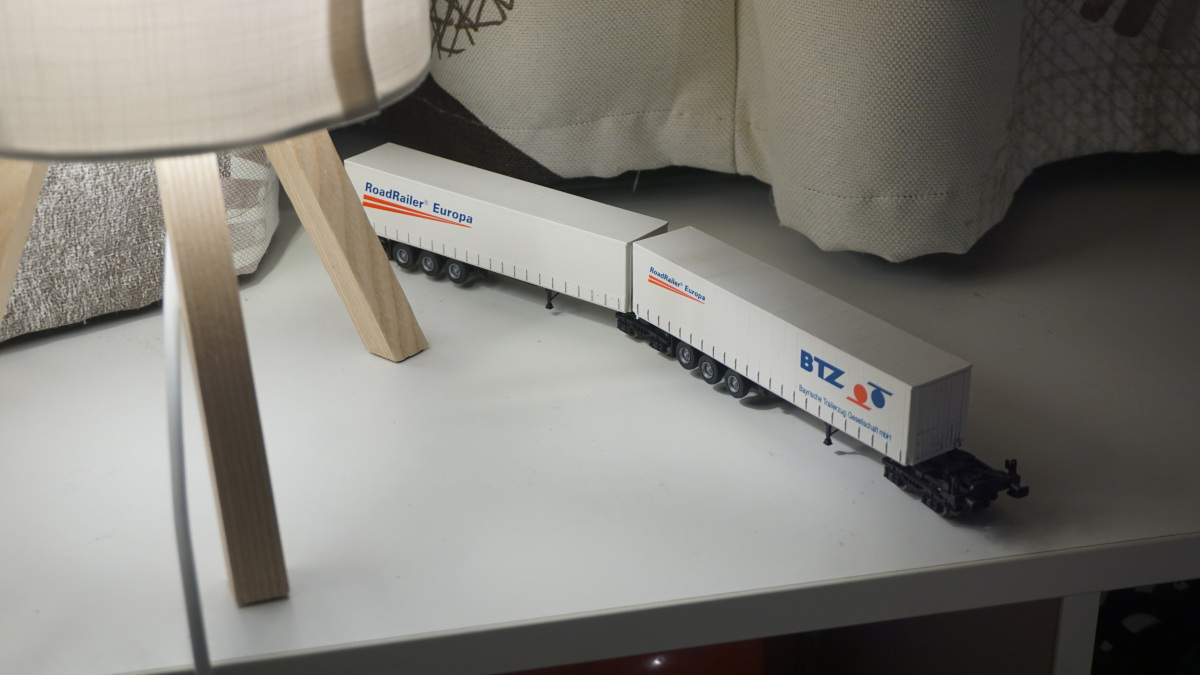
In the 1980s the success of RoadRailer in the US has created a bit of a hype among European railways. There were already a few intermodal solutions (not to mention countless concepts and prototypes) trying to redirect freight from increasingly congested roads back onto railways, but trailer-trains offered some unique advantages over already established technologies like ISO containers and pocket cars. For example, trans-shipment from road to rail (or the other way) could take place without cranes to lift trailers or containers onto train cars. Trailer-trains also promised to be highly efficient as the trailers would be considerably lighter than the equivalent railway car and the close coupling between trailers reduces both aerodynamic drag and the length of the train.
RoadRailer Europa
Wabash National acquired the rights to RoadRailer in 1991 and began to capitalise on this interest, creating RoadRailer Europa and getting a version of the RoadRailer system approved by German, French, Danish and Austrian railways within a year1. As far as I can tell, this was the most widely used system in Europe, at least by number of trailers and bogies.
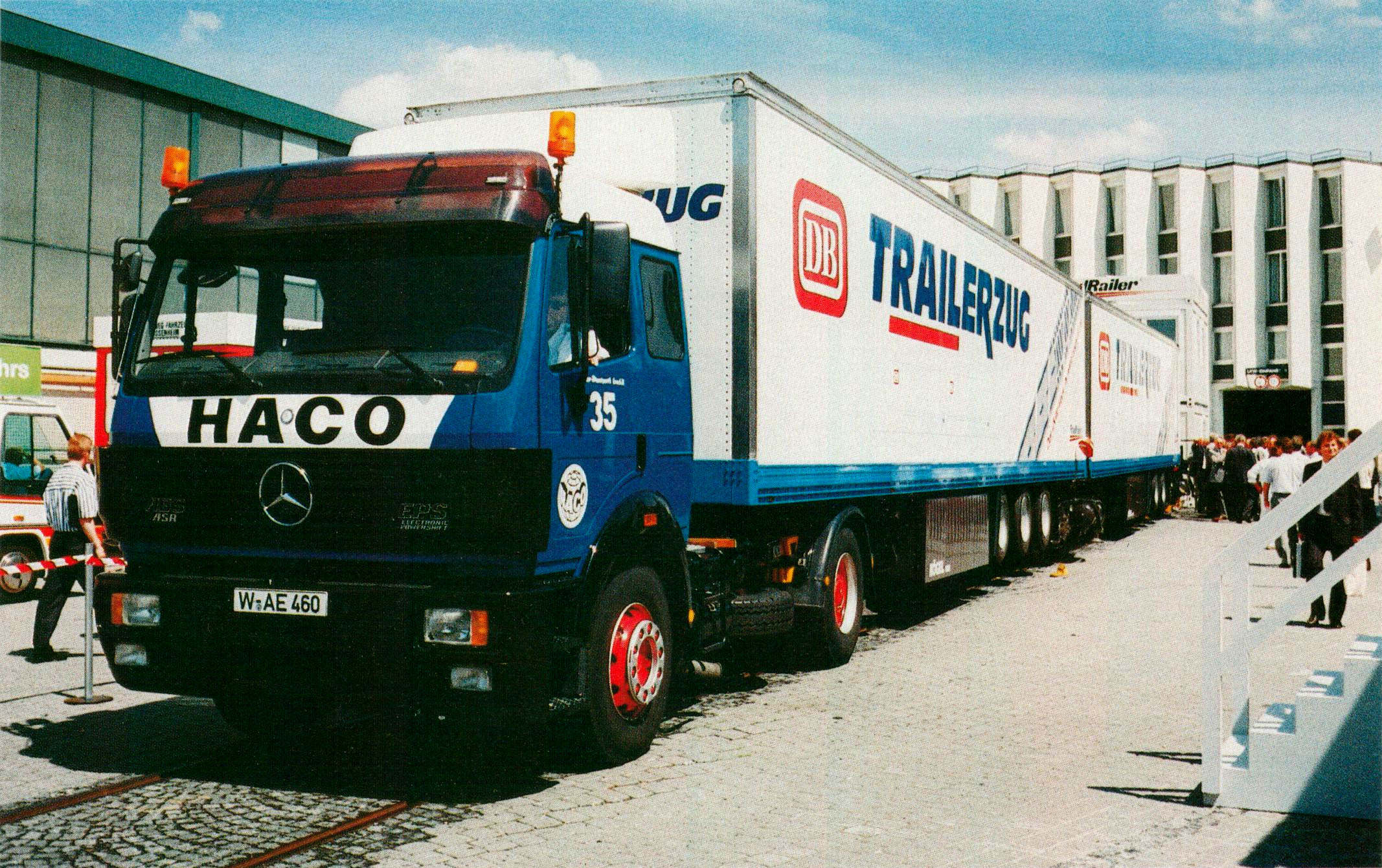
Much like the US counterpart, trailers had a short towbar on the front and a corresponding slot on the rear2. The adapter bogies would connect to the underside of the trailers at the rear end. At the front and rear of a RoadRailer train special bogies with buffer and chain couplers allowed other railway cars or locomotives to be coupled. This system used a variant of the ubiquitous Y25 bogie equipped with self-contained continuous brakes3.
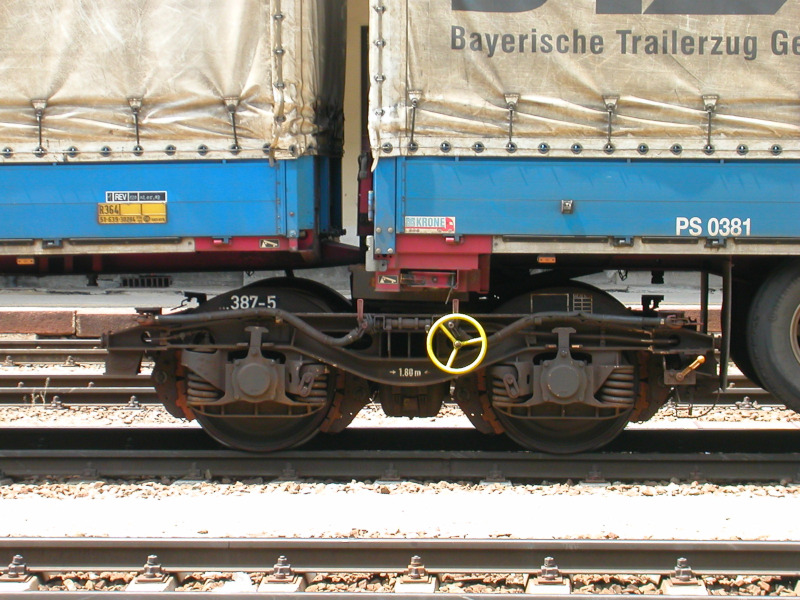
Bayerische Trailerzug Gesellschaft
Bayerische Trailerzug Gesellschaft was created in 1991 for the express purpose of operating RoadRailer trains4. Starting with 150 trailers and 78 bogies5, regular operation began in 1995 between Verona and Munich and expanded rather quickly3. A Soltau-Verona service followed in 1996 and a terminal in Soltau was opened in 19993. By the end of 2000 the fleet has expanded to 520 semitrailers and 272 bogies6, but services stopped in 2002, and the company filed for bankruptcy a year later.
Why BTZ failed
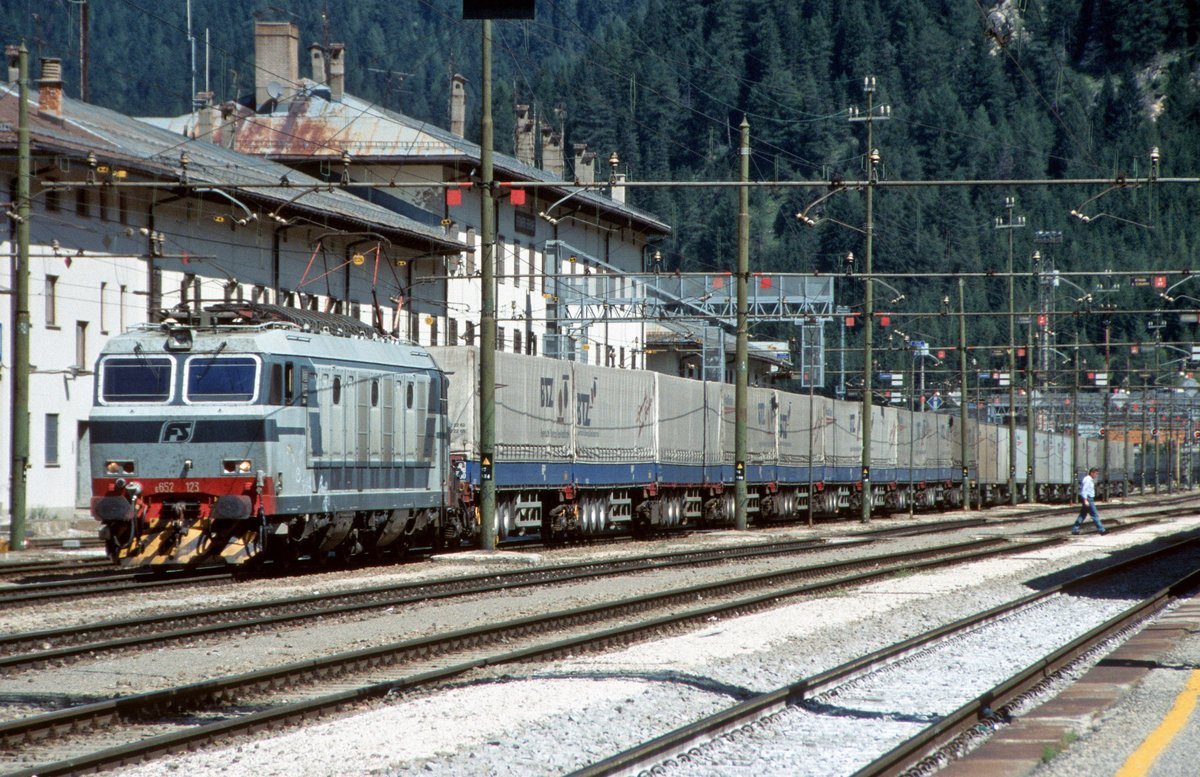
Some of the documents I found analyse the reasons BTZ was unsuccessful, highlighting the drawbacks of RoadRailer and trailer-trains in general. For example, while they are light and efficient as trains, the trailers were about 970 kg heavier than ordinary semitrailers due to the stiffer frame, reducing their load capacity7. Conversely, during railway operations trailers could not easily be uncoupled from each other for shunting. BTZ operated unit trains, which generally avoids that problem, but steep grades in the Brenner pass still required trains to be split8.
It wasn't all down to shortcomings of the system though, various economic factors also played a role. The German government originally planned to introduce a toll for lorries (LKW-Maut) on motorways before 1993, but this was delayed until 2004, making railway transport less competitive on cost. Compounding this problem was the pricing policy of DB, which charged rail operators based on how many trucks were loaded rather than train weight8.
Other companies using RoadRailer Europa:
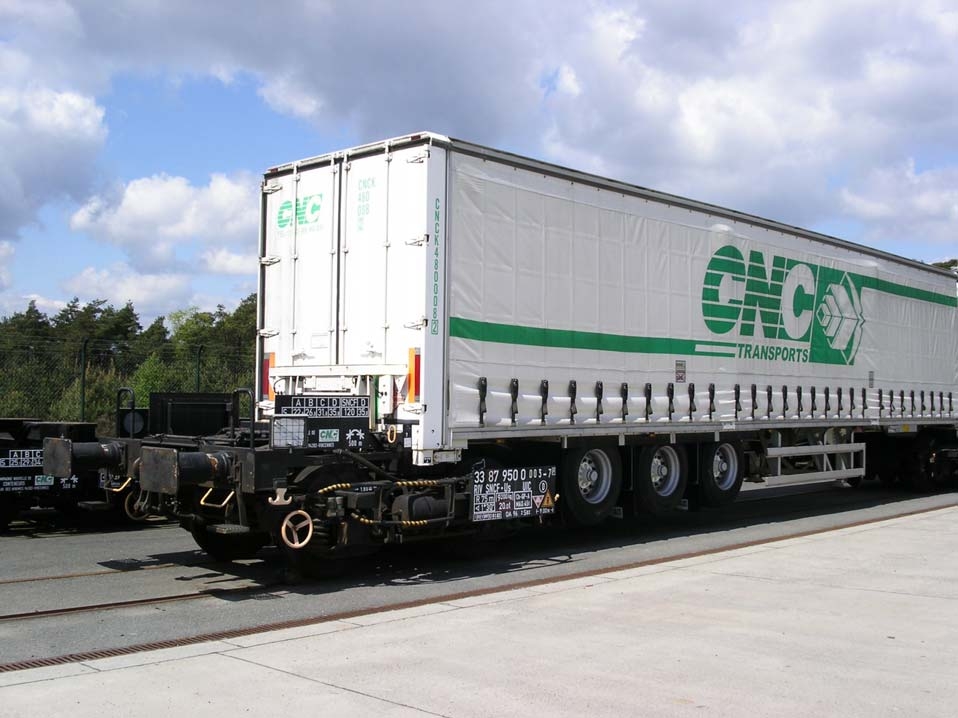
SNCF (French National Railways) purchased a total of 35 adapter bogies3 and 30 curtainside trailers2,9 through its intermodal subsidiary CNC in 1996, but I have no further information about French RoadRailer operations other than a few passing mentions of a regular service. Apparently the bogies were sold off and repurposed as spares in 20063.
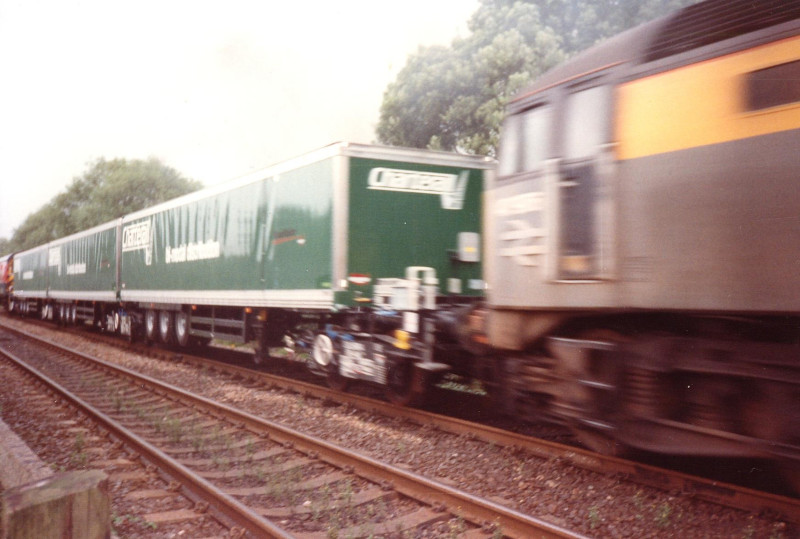
Charterail was a joint venture between British Rail and private investors that started running intermodal trains using piggyback cars in 19919. The company reportedly signed an order for 100 units in 1992 with a prototype unit consisting of three trailers to be delivered in February of that year1. Charterail went bankrupt in August 1992. However, that timeline is a bit muddled by the few photos I found, some of which were reportedly taken in 1989.
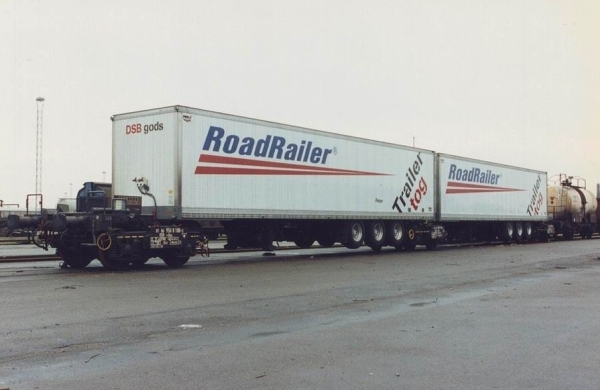
DSB (Danish State Railways) purchased a demonstration unit consisting of two trailers and three bogies in 1990 as part of a project called TrailerTog in cooperation with Deutche Bahn. These were exhibited at a conference in 1992, and test runs took place, but eventually the trailers were only used on road, and the adapter-bogies were scrapped in 199710.
Kombirail / Kombitrailer
Another system called Kombirail was created by Ackerman-Fruehauf, Talbot and Remafer12, apparently as a combination of two distinct systems called “Kombitrailer” developed by Ackermann-Fruehauf and “Semirail” developed by Talbot or Remafer7,8, but the distinction between these systems is unclear. The system was presented (along with RoadRailer Europa) at the Transport '90 expo in Munich13.
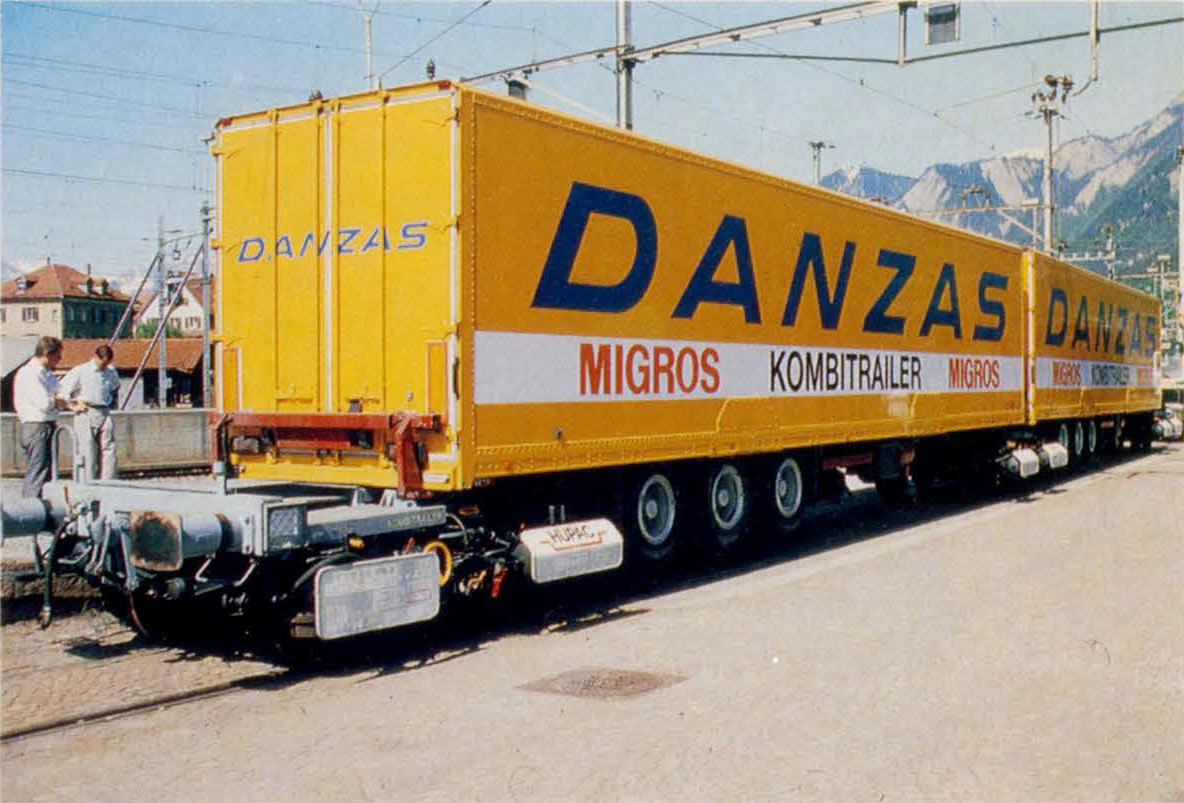
Unlike RoadRailer, the trailers connected to the adapter bogies on both ends. The trailers had additional kingpins on both front and rear (for a total of 3 per trailer) and the bogies had two fifth wheel couplers and a number of positioning pins to keep the trailers aligned15. This system was based on the Talbot DRRS type bogie16.
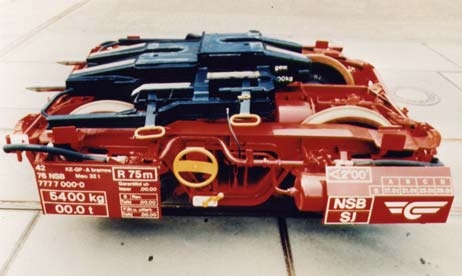
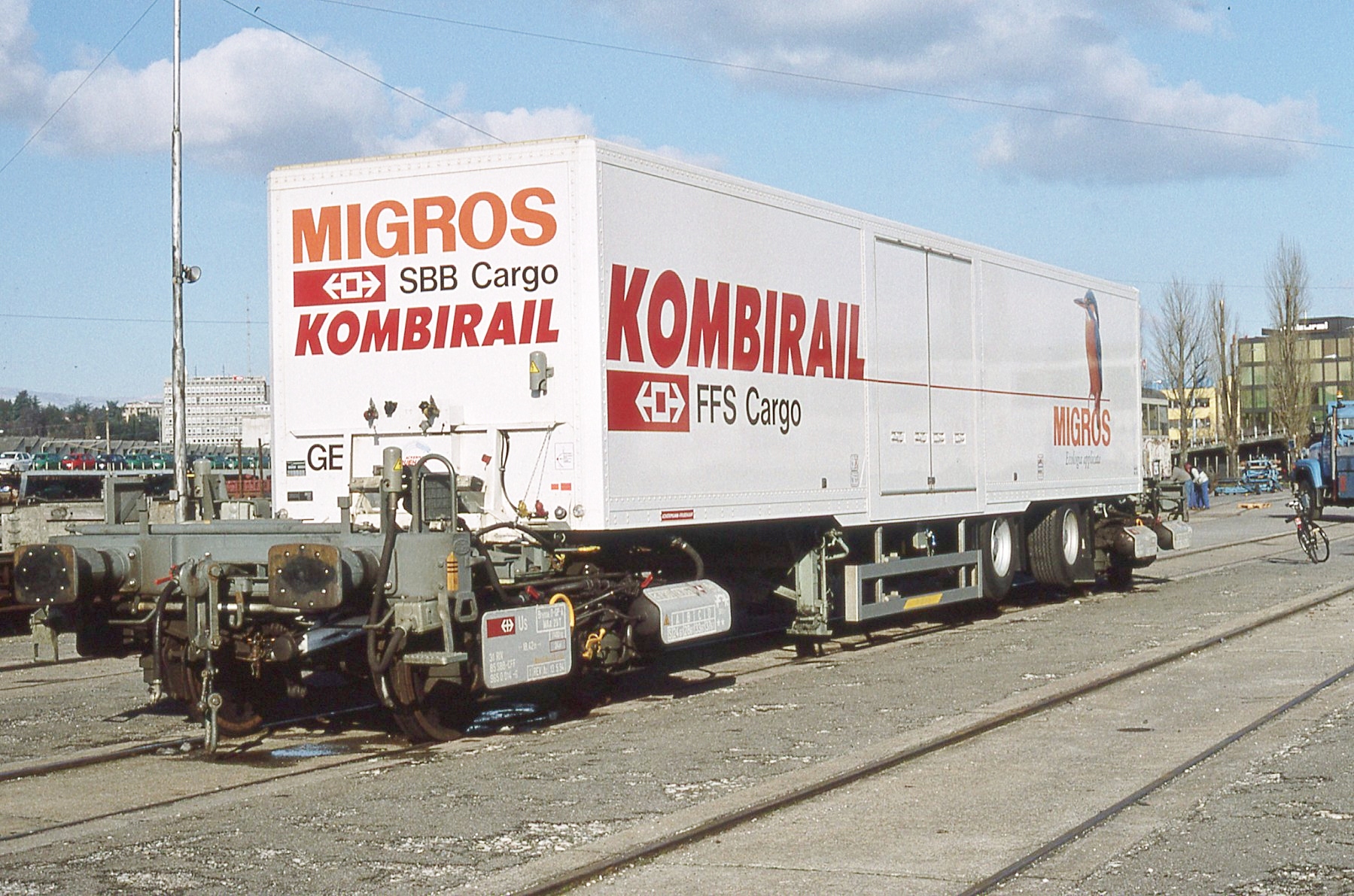
Swiss national railway SBB purchased 19 adapter bogies in 199316 and KombiTrailers were used to transport goods for supermarket chain Migros as late as 200017. Some photos show them in small groups of one or two trailers coupled into wagonload trains.
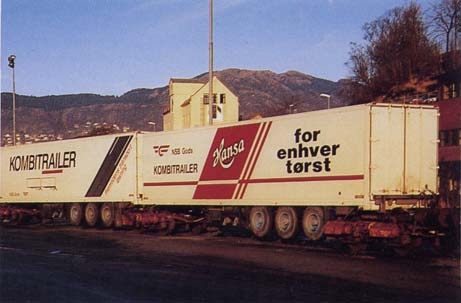
NSB purchased two end-adapters and a middle adapter along with two trailers16.
CODA-E
Stork Alpha Engineering began to develop the CODA-E system in 1985, although the idea of such a system was apparently proposed by an NS employee as early as 197212. The name is an acronym for Combinatie Oplegger Draaistellen Alpha-Engineering, roughly "Semi-trailer bogie combination Alpha-Engineering"18. A prototype was presented in December 1989 during NS150 in Utrecht18.
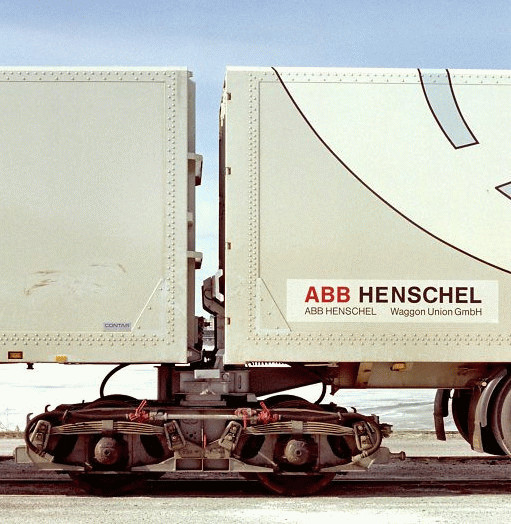
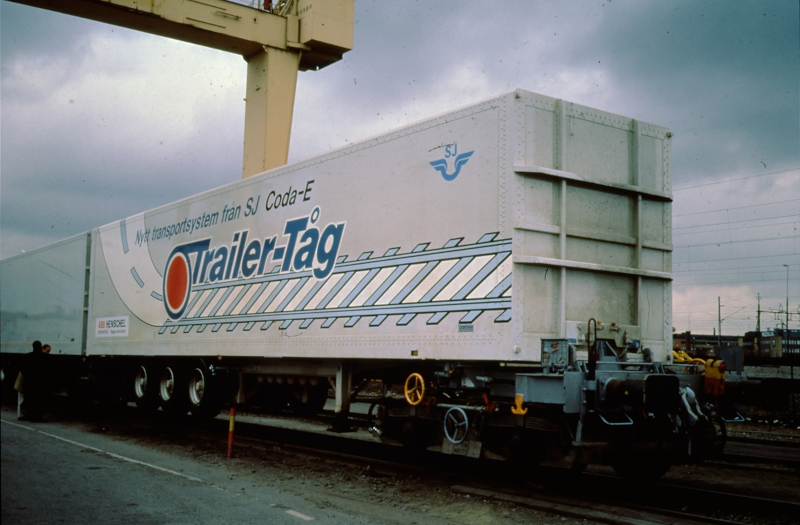
CODA-E was tested by SJ (Swedish State Railways) in 199112 and NS (Dutch Railways) in 1991 and 199218. The exact timeline is unclear, but evidently the same three units (prominently emblazoned with the words "Trailer-Tåg") were tested by both companies. Apparently there was regular service along the Helsingborg-Göteborg-Stockholm line and Dutch road transport company Bunnik had a shuttle service operating between Gouda and Veendam, but I could not find any specifics about either. At any rate, CODA-E was not in use for for long18.
Others
About half a dozen other systems are mentioned in various sources, but these rarely go beyond listing them and the companies involved with each. Some of these I could also find photos of:
- Trailer Train developed by York Trailer and Tiger Rail in the UK
- Carro Bimodale developed by Breda and Ferrosud in Italy
- Transtrailer developed by Transfesa in Spain
Others seem to have left little more than patents: Rail Trailer (Sambre et Meuse), Combitrans (Intermotra) or the "3R Intermodal System" (Innotermodal). I suspect the abundance of incompatible systems didn't help widespread adoption of trailer-trains in Europe.
In the 2010s, US-based RailRunner Inc tried to revive trailer-trains in Europe. Their system utilised a unique bogie design with air suspension.
Acknowledgements
I would like to thank NVBS for providing a copy of the article "RoadRailer, Trailerzug en CODA-E" from the October 2020 issue of Op de Rails as well as Petr Litomyský, Dave Bower, Reinhard Kühn, Alf Blume and André Knoerr for their photographs.
Sources
- Roadrailer announces sale of 100 units to UK company (Journal of Commerce, 28 January 1992)
- Riding the Rails (Road-Rail Hardware, 9 January 1997)
- www.drehgestelle.de/6/Y25_zusatz.html
- Roadrailer trailer to make intermodal debut (Journal of Commerce, 17 May 1995)
- Strafzoll für Schlaue (Der Spiegel, 9 June 1996)
- Geschichte der UIRR und des Kombinierten Güterverkehrs Schiene-Straße in Europa 1970-2000 (UIRR, 2001)
- Analysis and Comparison for Intermodal Transport Chains in European Markets: Handling and Transport Techniques (SGKV, 2010 January)
- RailRunner Feasibility on European Rail Itineraries (SGKV, 2006)
- Bimodal service debuts in Britain (Container News, 1 May 1991)
- www.sebtus.de/steckbrief_dsbg_uss.html
- kdmt.uniza.sk/files/podklady/TPKP/F_98.pdf
- Intermodal Transshipment Technologies – an Overview 1998
- DB-Trailerzug und Kombitrailer auf der "transport '90" in München (Deutches Eisenbahn Archiv)
- Migros Jahresbericht 1992
- kdmt.uniza.sk/files/podklady/TPKP/F_129.pdf
- www.drehgestelle.de/6/gummi_drrs.html
- Akzeptanz einer nachhaltigen Verkehrspolitik im politischen Prozess: Deutschland, Niederlande und Schweiz im Vergleich (Thomas Widmer et al.)
- RoadRailer, Trailer-zug en CODA-E (Op de Rails, October 2020)